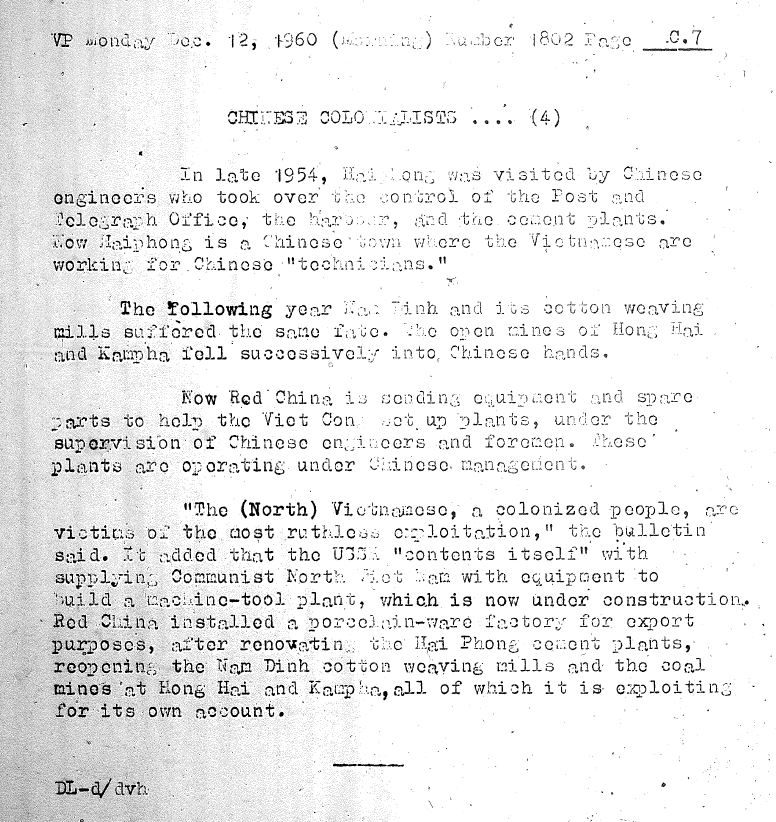
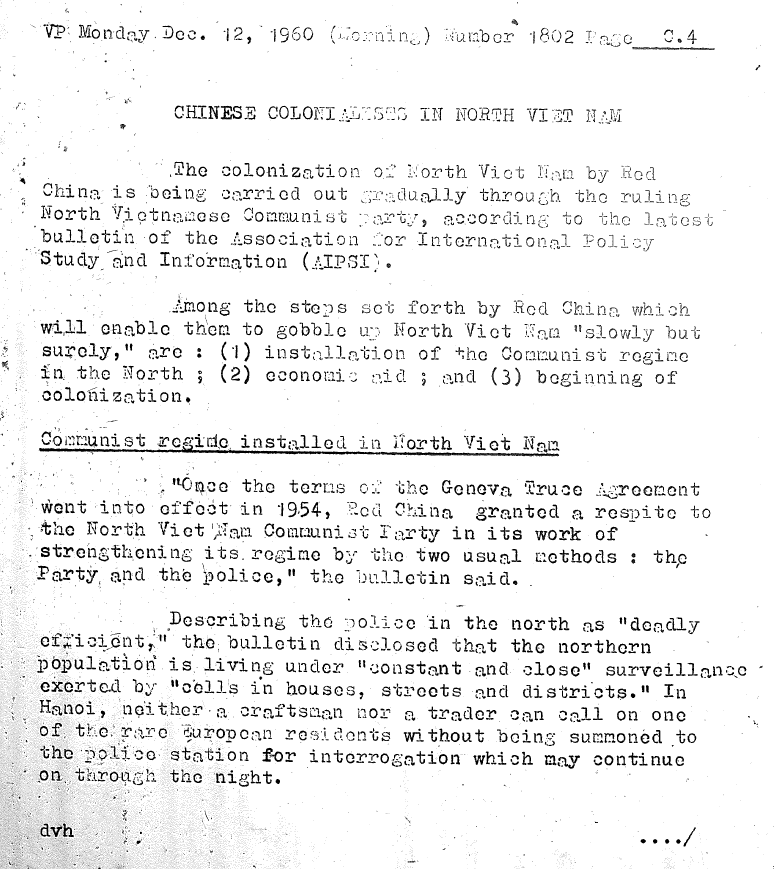
Commentary: China and Vietnam share the same political regime system. Vietnamese communists consider the Chinese communists as big brothers and take inspiration and orders from the Chinse Communist Party. Vietnamese leaders usually visist Chinese leaders for consultation for their preparation of the Vietnamese Communist Party national congress and the selection of the future leaders of the party. Despite the close ties with the Chinse Communist Party, Chinese leaders have not given up the dream of occupying Vietnam as China colonized Vietnam for 1,000 years from 111 BC – 938 AD.
Ever since, China has unsuccessfully attempted to invade Vietnam on
several occasions. Vietnam was the only country in the region to be able
to repel the Mongol invasions in 1257, 1284, 1288, and the Manchus
invasion in 1789. Despite of great civilization and people, China
succumbed to the foreign invasions and was fully colonized by the
Mongols from 1271-1368 (Yuan dynasty) and the Manchus from 1644-1911 (Qing dynasty).
Vietnam has formally protested to China over so-called “invasion plans” appearing on mainland websites that purport to detail the complete military occupation of the country by China.

Hanoi
has twice summoned senior Chinese diplomats to voice its concerns over
the material which, while unsourced and apparently unofficial, has
alarmed diplomatic and military elites in the Vietnamese capital after
appearing repeatedly over the past month.
The supposed
plans detail a 31-day invasion, starting with five days of missile
strikes from land, sea and air and climaxing in an invasion involving
310,000 troops sweeping into Vietnam from Yunnan, Guangxi and the South China Sea. The
electronic jamming of Vietnamese command and communications centres is
mentioned, along with the blocking of sea lanes in the South China Sea.
“Vietnam is a major threat to the safety of Chinese territories, and the biggest obstacle to the peaceful emergence of China,” the plans posted on Sina.com and at least three other websites say.
“Also,
Vietnam is the strategic hub of the whole of Southeast Asia. Vietnam
has to be conquered first if Southeast Asia is to be under [China's]
control again.”
“From all perspectives, Vietnam is a piece of bone hard to be swallowed.”
In a
statement to the South China Morning Post, Vietnamese Foreign Ministry
spokesman Le Dung confirmed Beijing officials had been asked “to act so
that such negative articles will not appear again since these may be
harmful to bilateral relations”.
“This
is irrelevant information which goes against the trend of peace,
friendship and co-operation for development in the region and the world
and is not in the interests of the fine relationship existing between
Vietnam and China,” Mr Dung said.
He
added that China acknowledged Vietnam’s request and “stated that the
article did not reflect the position of the government of China”.
A
Foreign Ministry spokesman in Beijing, meanwhile, said the “different
voices” on the internet represented individual acts “by only a handful
of people, which by no means represented China’s stance”.
“The
Chinese government attaches importance to the development of
Sino-Vietnamese relations and is actively committed to strengthening
publicity of the Sino-Vietnamese friendship,” he said.
Vietnamese
government sources said they were perplexed that articles remained
online, as they believed China actively policed the content of mainland
sites.
Many officials believe the articles may have been sparked by rising tensions over the disputed South China Sea,
where Beijing has recently been trying to pressure international oil
firms into pulling out of their exploration contracts with Vietnam.
The
Post reported in July that Chinese envoys had warned ExxonMobil – the
world’s largest oil firm – that its future mainland business could be at
risk unless it pulled out of deals in Vietnam’s southern and central
oil fields. ExxonMobil executives say Vietnam’s legal position is
strong.
Song
Xiaojun, a Beijing-based military expert, described the internet-based
plans, one of which was subtitled “One battle to set the region in
order”, as a joke.
“It is, at most, a game by a few military amateurs and it has no military value at all,” he said.
He said there were still some people in both countries who could not forget the nations’ old animosities.
“China
and Vietnam have similar political systems and should unite to counter
the US, which is the common enemy for both countries,” he said. “Clearly
the US tries to play Vietnam off against the rising China.”
Mr Song described US company ExxonMobil’s oil exploration work in the South China Sea as provocative.
“We
should be on the alert for possible conspiracy theories behind the
so-called invasion plan and other provocative stuff. Sensible people in
both countries are well aware that China has no reason to think of
invading Vietnam as it needs to make good friends with its neighbours.”
He said the mainland government should also learn a lesson from the issue.
“Authorities
should be responsible to guide public opinion towards other countries
and make its own stance on confusing issues clear and understood. The
government should not leave any chances for troublemakers and harmful
speculations.”
Carl
Thayer, a veteran Vietnamese military analyst at the Australian National
University, said it was unthinkable that China would consider such an
invasion in the modern regional context, but he warned that the case
highlighted the potential for “extreme nationalism” on both sides.
“It may
well become part of a tit-for-tat trend. China objects to anti-Beijing
protests in Hanoi and then Vietnam feels it must react to something like
this,” Dr Thayer said.
Current
Vietnamese military strategy has long been geared towards deterring
China from backing its territorial claims by force, he said.
China
is Vietnam’s biggest source of imports and both governments have worked
to rebuild ties in recent years, despite lingering tensions after the
brief but bloody border conflict of 1979.
As well as deepening fraternal ties between communist party
leaders, both sides have made progress in solving disputes over the
1,400km land border and the Gulf of Tonkin. Rival claims to the
potentially oil-rich grounds beneath the Spratly Islands in the South China Sea remain a key point of friction, however.
Source : Here